Awards as a measurable channel.
One workspace from the moment an award appears on your radar to the moment your CFO sees the ROI.
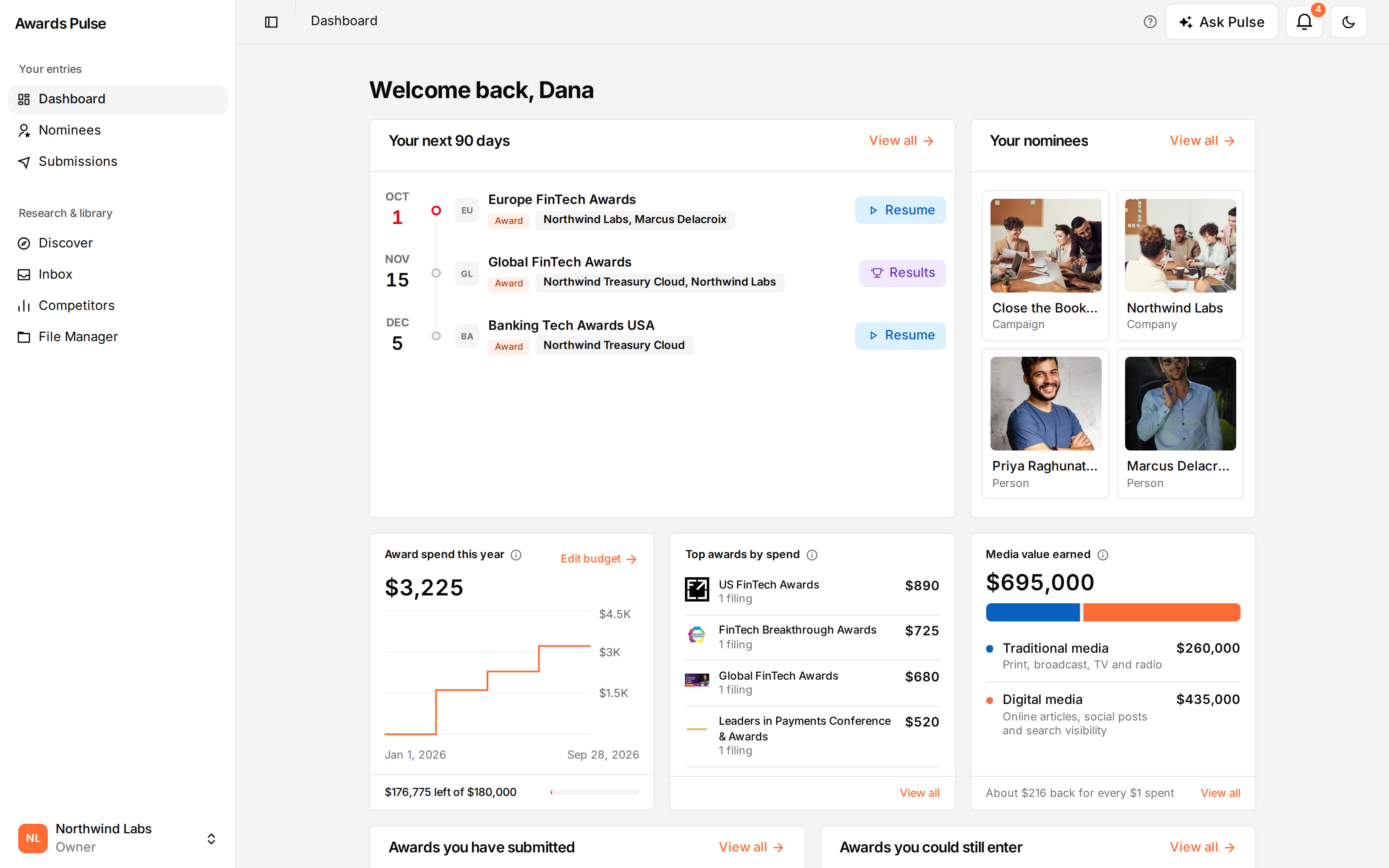
Scored, not listed
Every program ranked 0–100 against your real profile.
Drafted, not blank
Each section written from your own evidence, to the word count.
Tracked to the dollar
Entry fees, deadlines and what the coverage returned.
Awards as a measurable channel.
One workspace from the moment an award appears on your radar to the moment your CFO sees the ROI.

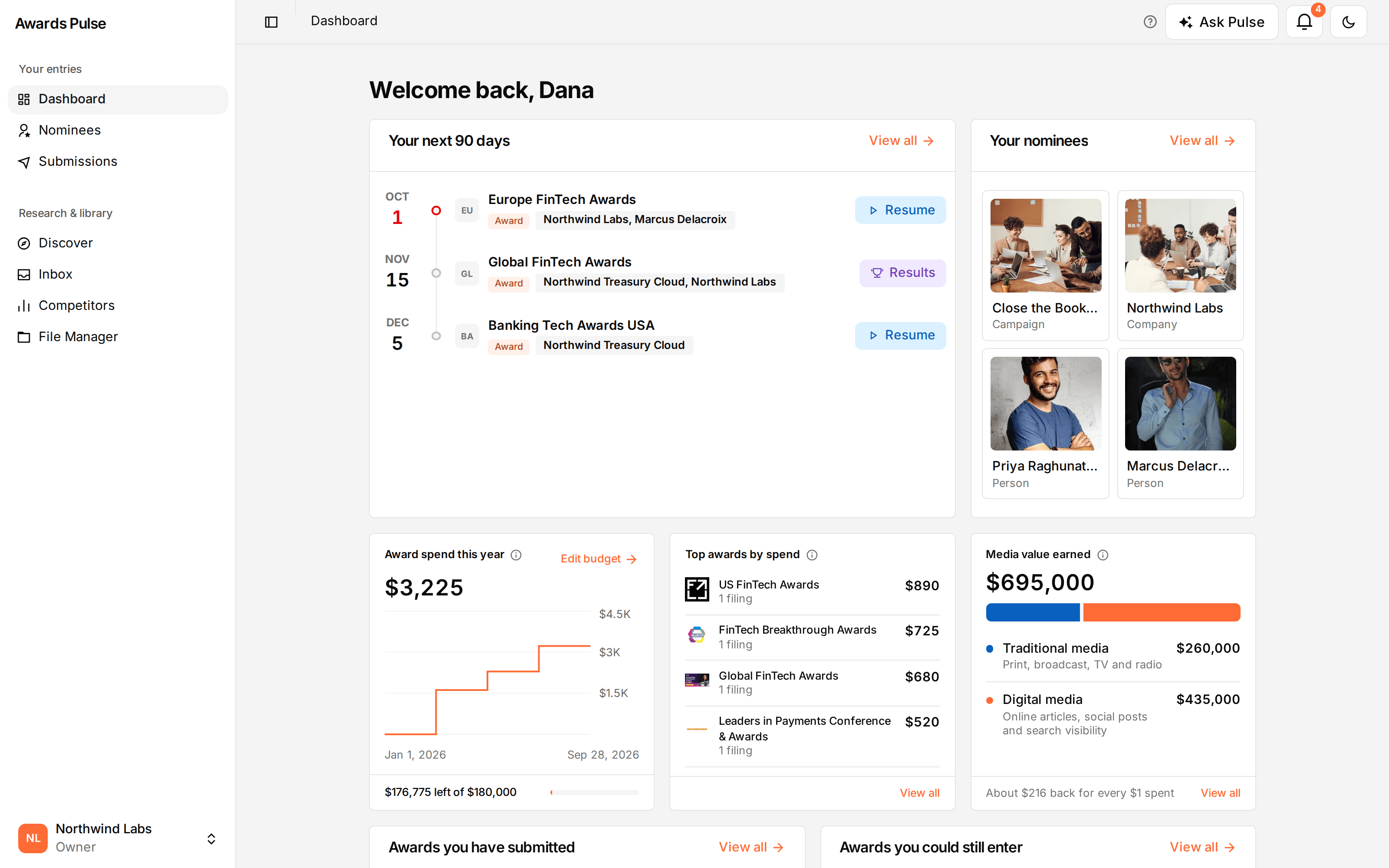
Scored, not listed
Every program ranked 0–100 against your real profile.
Drafted, not blank
Each section written from your own evidence, to the word count.
Tracked to the dollar
Entry fees, deadlines and what the coverage returned.
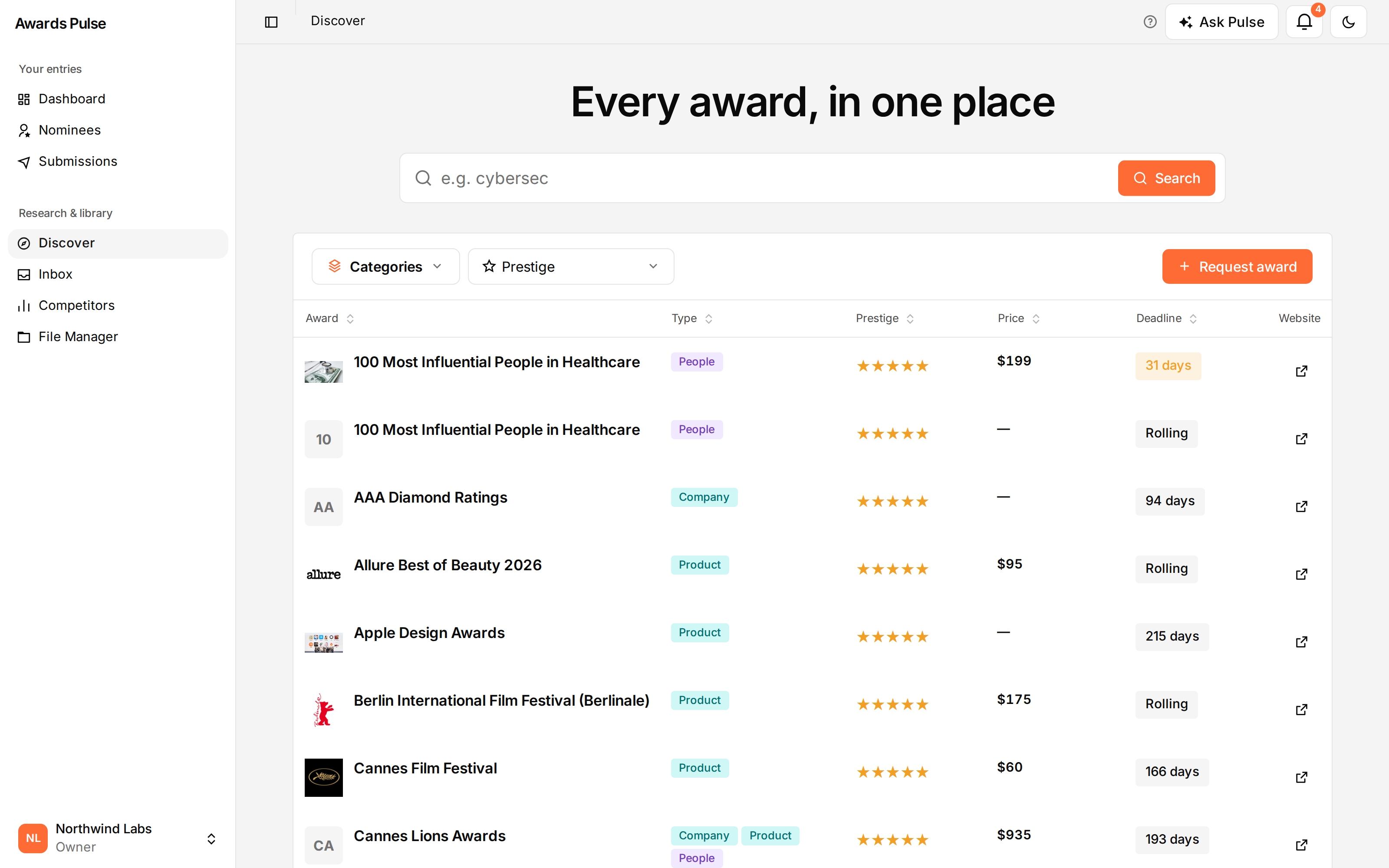
The whole workflow
One workspace, from the first match to the CFO's number.
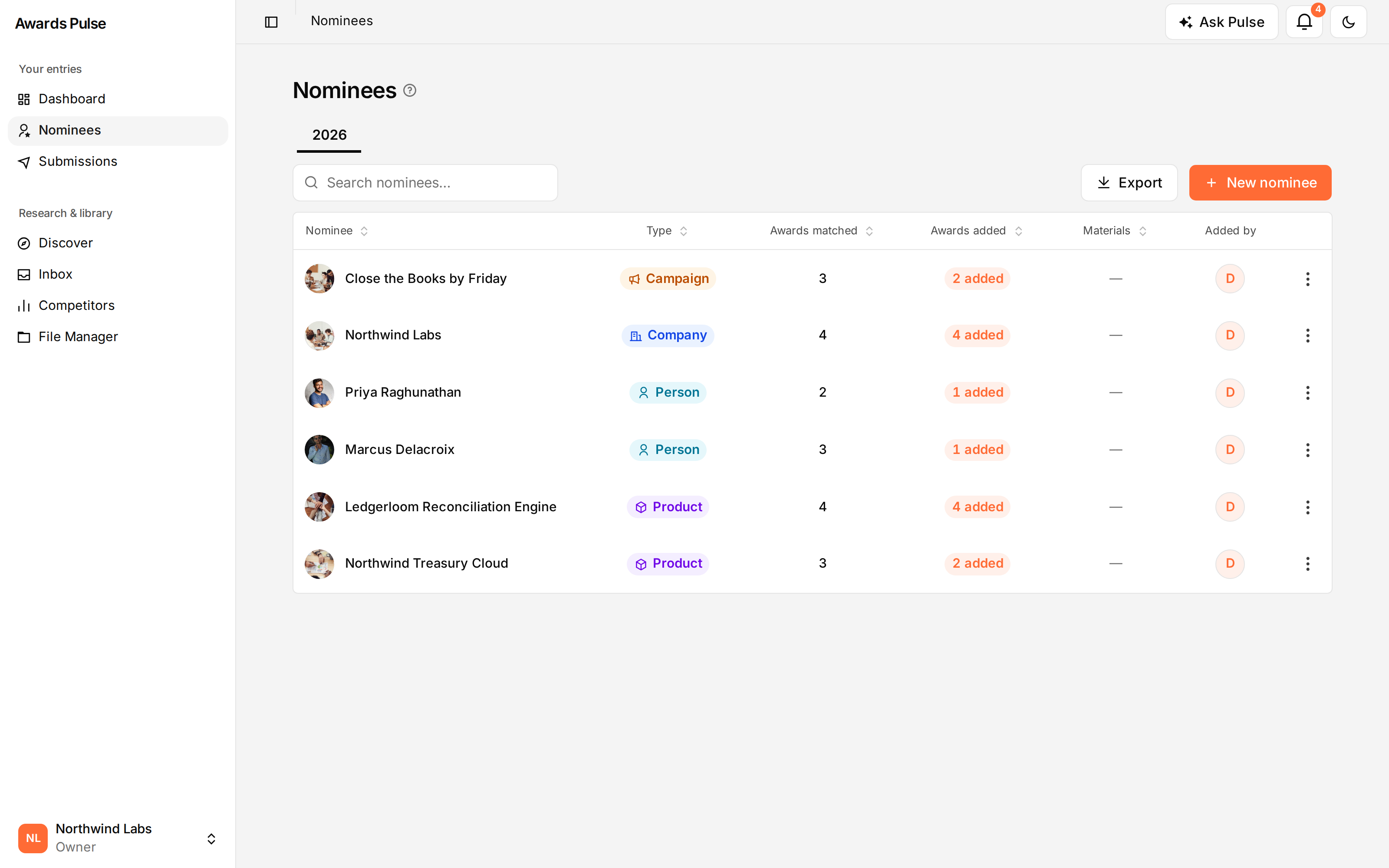
Four screens do the whole job. Nothing lives in a spreadsheet, and nothing waits on somebody remembering a deadline.
What happens after you drop in a file.
Five steps, and only the first one is yours. Everything after it runs off the evidence you have already produced.
You drop in what you already have.
A deck, a case study, a press page, a resume, an old submission. Every file is read once and indexed into the evidence vault, so the next twenty entries draw on it without you uploading anything again.
Every program is scored against it.
Industry, stage, geography, customer evidence and past wins produce a single 0–100 for each of 1,000+ programs. A 94 means the criteria line up with what you can prove. A 30 tells you what evidence you are missing.
The entry gets drafted, section by section.
Each field is written from your own material, to the form's exact word counts, in the voice of what you have already published. What used to be six hours is twenty minutes of review.
You file it, and it stays tracked.
Submitted, shortlisted, finalist, won. Every deadline, fee and result sits on one tracker, and a read-only link sends any entry out for sign-off without giving anyone an account.
The spend turns into a number.
Entry fees against budget, cost per filing, win-rate by category, and what the coverage a win produced was actually worth. One screen, and it is the one your CFO opens.
The parts nobody demos
Access, ownership, and the tools you already use.
Who can see what
- Each client runs as its own workspace
- Owner, admin and member roles per workspace
- One master account rolls every client up
- Read-only share links, no account required
- Approve or request changes from the link
Where your evidence lives
- Single sign-on, no passwords to manage
- Files and drafts scoped to one workspace
- Your material trains nothing and leaves nothing
- Every action attributed in the activity log
- Export and take it with you at any time
How it meets your stack
- MCP server, so Claude can drive the workspace
- Chrome extension for clipping a program you find
- Word export for the entries that want a document
- CSV and PDF out of every list and report
- Share links for the people without a seat
Everything your team needs
Every question answered before you ask.
Your boss sent you to check this out. Here is what they are going to want to know.
What does it actually do?
1,000+ programs, scored against your profile.
Not a directory you search. Every program in the catalog is ranked 0–100 against your industry, stage, geography, customer evidence and past wins, so the shortlist is the ones you can win rather than the ones that exist.
Will the writing sound like us?
Every draft is built from your own material.
The drafter reads your case studies, prior entries, product pages and internal docs, and writes each section to the form's exact word counts in the voice of what you have already published. You review; you do not start from a blank field.
What happens to what we upload?
Scoped to your workspace, and yours to take back.
Files and drafts belong to one workspace and are visible to the people in it. Your material trains nothing. Every list and report exports, so leaving costs you an afternoon rather than your archive.
We run this for clients. Does that work?
Every client is its own workspace.
Separate matches, submissions, staff and files, switched from the top bar, with an agency view that rolls all of them into one dashboard. A client never sees another client, and one case study becomes twenty entries without twenty rewrites.
What does it cost us in hours?
Twenty minutes an entry instead of six.
That is the whole economic argument. The entry fee is not what an award costs you — the six hours somebody spends rewriting the same three paragraphs is, and that is the number this moves.
Does it fit the tools we already use?
MCP, a Chrome extension, Word, CSV and PDF.
Connect the MCP server and run the workspace from Claude. Clip a program you find with the extension. Take an entry out to Word, a list to CSV, a plan to PDF, or send a read-only link to somebody with no account at all.
And the two most teams never get.
Judge matching
Agency client workspaces

See it against your own profile.
A 20-minute walkthrough, run by someone who lives in awards full-time.
How it actually works.
The questions teams ask about the matching, the drafting and the reporting.
Ask a question